Maple
Skeeter's Broom
Acer palmatum
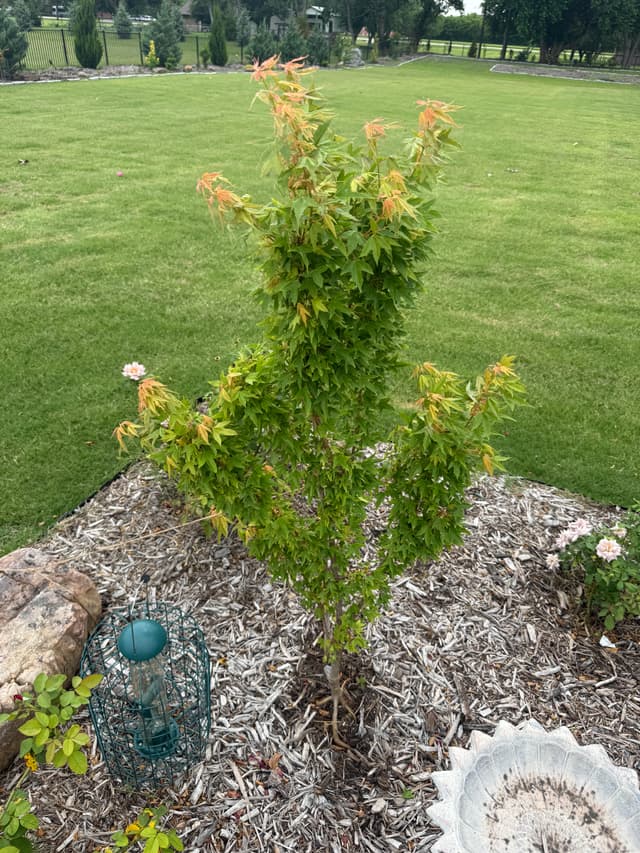
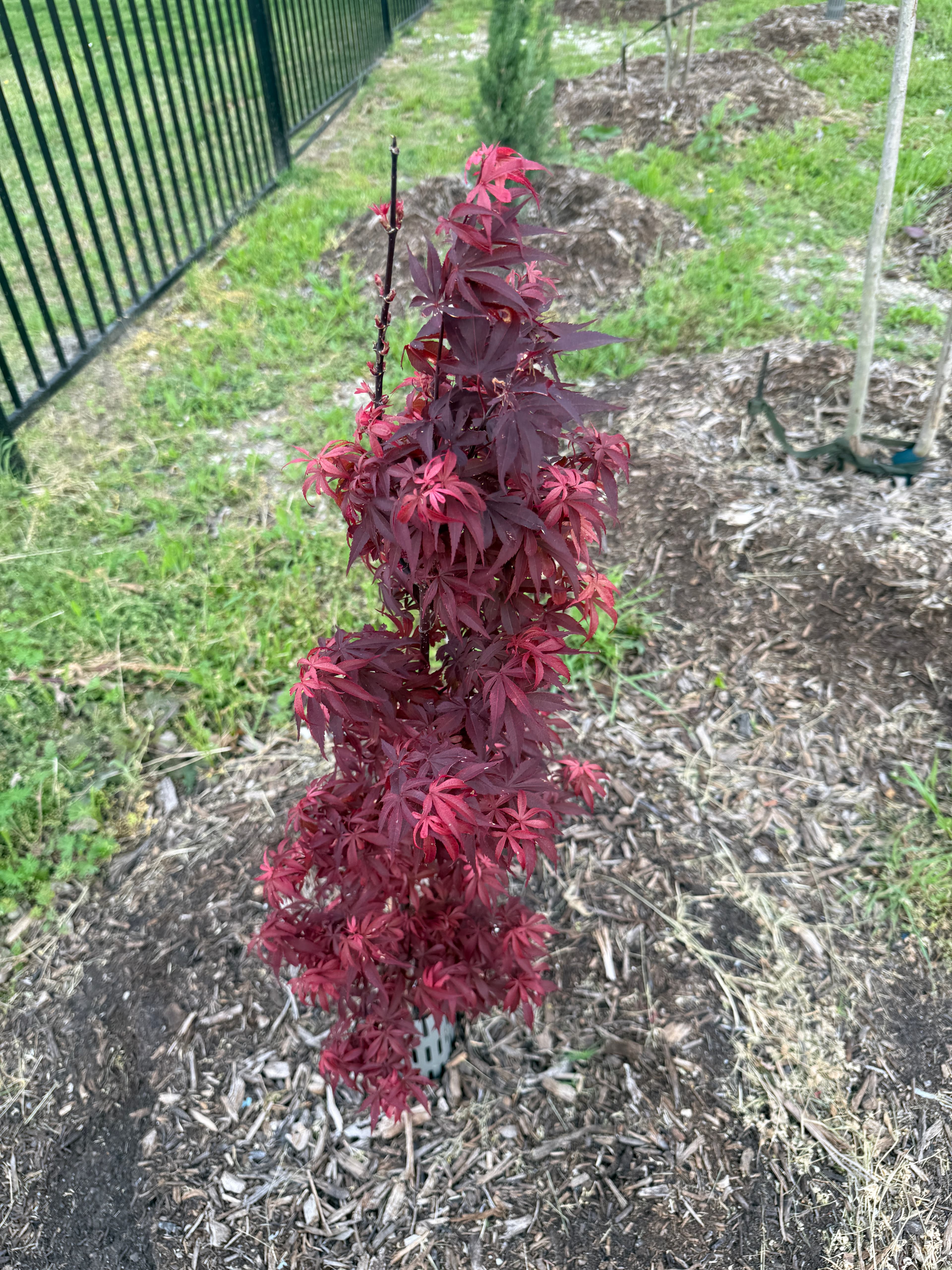
An exceptional, highly structured semi-dwarf upright red Japanese Maple. 'Skeeter's Broom' is highly distinct due to its strictly narrow, columnar-to-slender vase growth habit and short internodes. The palmate leaves are slightly smaller than its parent line, emerging a brilliant, translucent fire-engine red in spring. Throughout the intense summer months, the canopy matures into a deep, velvety maroon-purple that resists heat-fade remarkably well. In autumn, the slender column transforms into a striking exclamation point of uniform, glowing scarlet.
Growing Specifications
- Height
- 8-10 feet (Can reach 12 feet at long-term 15-year maturity)
- Spread
- 4-5 feet (Exhibits an incredibly narrow footprint)
- Watering
- Moderate; requires regular deep root soaking during peak summer stretches
- Light
- Full Sun to Partial Shade
- Heat Tolerance
- Excellent; inherits the robust cellular heat-stability of 'Bloodgood'
- Growth Rate
- Slow to Moderate (Maintains a neat, strongly vertical drive)
- Soil Requirement
- Loose, porous, organically rich, sharply well-draining, slightly acidic
North Texas Micro-climate Notes
Expert Curated Selection. Because it inherits the tough genetic backbone of 'Bloodgood', 'Skeeter's Broom' is a phenomenal choice for North Texas landscapes. Its smaller, rigid leaves reduce moisture loss via transpiration, allowing it to hold up beautifully against high ambient summer heat with minimal tip-scorch. Provide morning sun to maintain its tight, dense vertical branching, and shield it from brutal 3 PM southwest wind tunnels.
History & Lineage
- INTRODUCED BY
- Edward "Skeeter" Rodd (Raraflora Nursery)
- HISTORY
- Discovered growing as a prominent branch sport mutation on a mature Acer palmatum 'Bloodgood' specimen in the 1970s by the esteemed plantsman Edward 'Skeeter' Rodd at the historic Raraflora Nursery in Feasterville, Pennsylvania. Recognizing its immense architectural utility for compact, modern spaces, he carefully propagated the selection, which has since earned global acclaim among landscape designers.
Care Instructions
Must be planted slightly above grade in a highly porous, aggregate-heavy soil blend to avoid damp root stagnation. Provide slow, deep-soaking irrigation cycles at the base during summer droughts. Pruning is rarely needed due to its naturally well-behaved, strictly upright habit.
Landscape Usage
Sensational as a vertical exclamation point to frame doorways, planted in tight side-yards or slim foundation borders, or utilized as a high-contrast architectural focal specimen in a tall Japandi courtyard container.
Fun Fact
This tree didn't sprout from a standard cross-pollinated seed. It was discovered as a 'witches' broom'—a rare, naturally occurring genetic mutation that caused a single branch on an old 'Bloodgood' maple to grow completely miniature, dense, and upright. Grafted onto separate rootstock, that lone branch became this beloved cultivar.
Awards
Highly rated across international maple registries as the premier narrow-form upright red selection